
SmCo vs. High-Temperature NdFeB Selection: Thermal Demagnetization, Knee Points, and Motor Magnet Sourcing
Compare SmCo vs. high-temperature NdFeB motor magnets. Check thermal knee points, GBD limits, and sourcing criteria before sending an engineering RFQ to MagAtom.
SmCo vs. high-temperature NdFeB selection starts with the magnet's hottest operating point and the strongest opposing field it must survive. Shortlist high-temperature NdFeB when compactness and magnetic output are priorities and measured hot curves show adequate margin. Shortlist SmCo when temperature stability or the required hot demagnetization margin makes NdFeB difficult to qualify. Neither a grade suffix nor a catalog temperature rating approves a motor design.
Published and reviewed: November 11, 2026. Scope: Global, English-language engineering and procurement guidance for industrial motors, traction drives, aerospace actuators, and downhole equipment. This is a preliminary screening and RFQ guide. The examples and diagram are illustrative, with no claimed MagAtom motor test results. Application approval requires supplier data for the actual grade and geometry, electromagnetic and thermal analysis, and agreed component and assembly testing.
To initiate a technical review, send your drawing, rotor temperature envelope, reverse-field conditions, and quantity forecast through the MagAtom engineering contact form. Use the comparison matrix to shortlist candidates and the RFQ checklist to define the evidence needed before a purchase order.
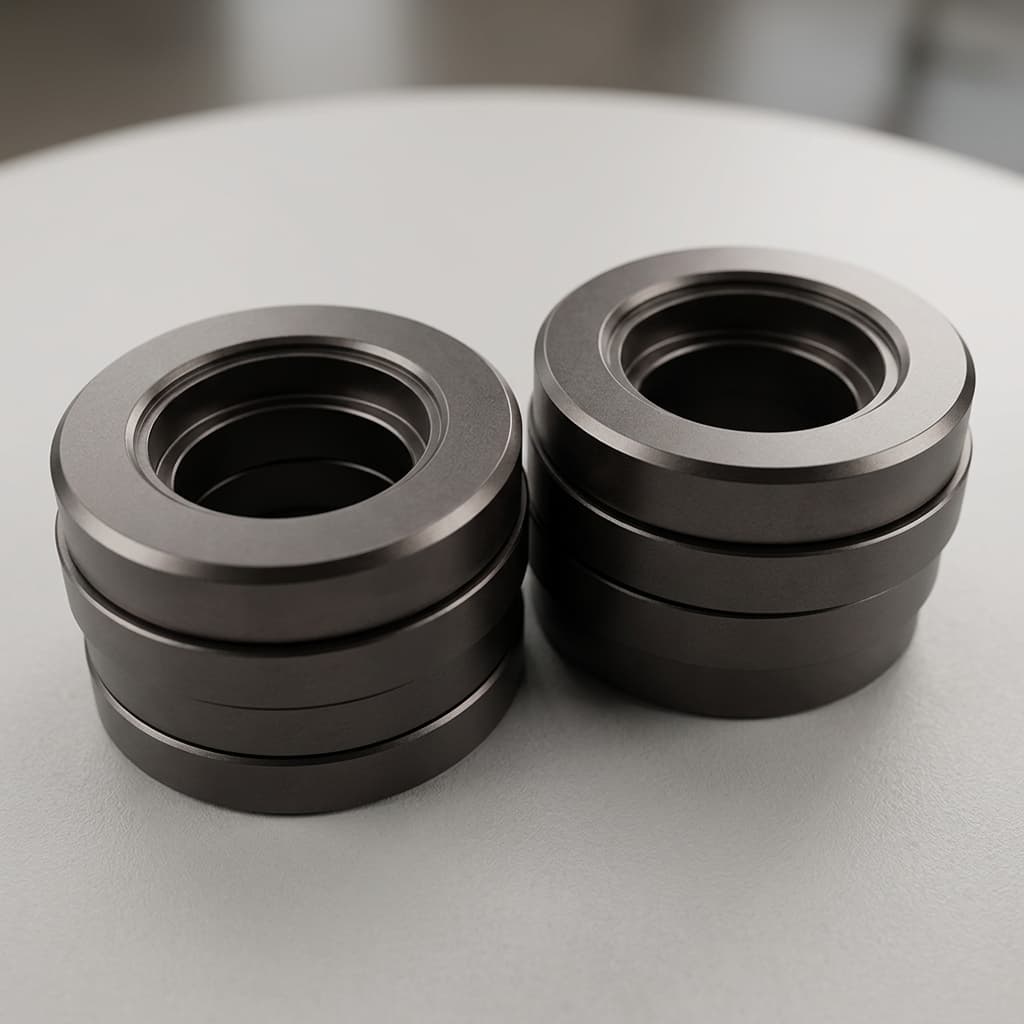
Header image: two stacks of metallic ring components from the site's product gallery. Appearance alone cannot establish alloy, magnetization, coating, or temperature capability.
1. Thermal demagnetization physics and second-quadrant knee points
The useful distinction is between a temporary change in magnetic output and a persistent change in the magnet's state. Procurement specifications should keep these separate because they require different acceptance measurements.
Reversible vs. irreversible thermal loss mechanisms
When a permanent magnet is heated inside an electric machine, three mechanisms need attention:
- Reversible flux loss: Remanence changes with temperature. The reversible component returns when the magnet returns to the reference temperature, provided no other loss mechanism occurred. A supplier's temperature coefficient applies over a stated interval; it should not be extrapolated indefinitely.
- Irreversible demagnetization: Temperature and opposing field can move part of the magnet beyond its useful demagnetization knee. Cooling alone does not restore the lost magnetization. Remagnetization may recover it if the material remains intact, but a finished rotor may be difficult to remagnetize uniformly.
- Material or assembly damage: Oxidation, cracking, adhesive degradation, and other physical changes can cause losses that remagnetization cannot repair. Crossing the Curie temperature destroys magnetic order while hot; that event alone does not prove permanent metallurgical damage. It is also not a permissible service-temperature criterion.
Measure reversible behavior at the hot operating condition. Measure irreversible loss by comparing flux before exposure and after return to the same reference temperature, using the same fixture and measurement method. Comparing a hot reading directly with a cold reading mixes both effects.
The demagnetization curve knee point
Two related curves describe a permanent magnet:
- The intrinsic J–H curve plots magnetic polarization J against field strength H.
- The normal B–H curve plots flux density B against H, with the SI relationship
B = J + μ₀H.
Br is remanence at zero applied field. Hcb identifies where B reaches zero; Hcj identifies where J reaches zero. Hcj is therefore not interchangeable with the knee field or with an allowable motor reverse field. The IEC 60404-5 measurement standard covers magnetic-property measurements, demagnetization curves, and recoil lines.
Define the knee criterion explicitly. For example, a supplier may report Hk at the field where J falls to 90% of Br; another convention or an allowable irreversible-loss criterion may give a different boundary. Use field magnitudes consistently when comparing negative second-quadrant fields.
As temperature rises, the hot curve and its knee can change substantially. SmCo often provides useful temperature stability, but it can still demagnetize under a sufficiently strong opposing field. A statement that its curve is always linear or that it has unconditional fault margin would be incorrect. Request curves over the complete service-temperature range and compare them with local fields inside the magnet, including edge regions.
2. Permeance coefficient and dynamic motor load lines
A permanent magnet operates at the intersection of its material curve and the magnetic circuit's load line. It does not normally operate at Br. For a passive circuit without externally applied MMF, the dimensionless SI permeance coefficient is Pc = −B / (μ₀H).
For a uniformly magnetized ellipsoid, the demagnetizing factor N gives Pc = (1 − N) / N along the magnetization axis. This idealization explains why a thin magnet in air can have a less favorable working point than the same magnet installed against an effective return path. Actual arc segments and rotor cavities are not uniform ellipsoids, so a single estimated Pc cannot describe every local operating point.
Open-circuit vs. installed conditions
The handling state matters. A magnet can experience a different load line during thermal exposure before installation than it does inside a rotor. Specify whether samples are heated in air, on backiron, inside a fixture, or in the finished assembly. A result from one arrangement cannot automatically qualify another.
A simple magnetic-circuit estimate can help compare geometries, but production analysis must account for magnet dimensions, air gap, leakage, saturation, and temperature. Avoid adopting one nominal Pc range for every surface-mounted or interior-magnet motor. Their magnetic paths and localized demagnetizing fields differ.
Stator counter-MMF and fault cases
Stator current adds an external magnetomotive force. At a fixed circuit geometry, this changes the load-line relationship; it should not simply be described as a universal reduction of geometric Pc. Evaluate at least three operating cases:
- Field weakening: Negative d-axis current reduces effective magnet flux at high speed. The relevant limit depends on the current-control strategy and the hot material curve.
- Peak torque and overload: High current can create localized opposing fields. Rotor position and saturation affect where the highest exposure occurs.
- Electrical faults: Short circuits and inverter faults require machine-specific transient analysis. There is no universal multiple of rated current that qualifies every motor.
Overlay local operating trajectories on the supplier's temperature-dependent curves. Check temperature, current duration, rotor position, and manufacturing tolerances together. Average magnet flux can conceal a demagnetized corner, so a satisfactory average output is insufficient evidence of local margin.
A reproducible margin example
Suppose an illustrative hot knee-field magnitude is 800 kA/m under an agreed definition, and analysis predicts a worst local opposing field of 600 kA/m. The field gap is 200 kA/m. Expressed as a fraction of the knee magnitude, the margin is (800 − 600) / 800 = 25%; expressed relative to the operating field, it is 33.3%. These are different conventions.
This arithmetic is a screening example, not a recommended acceptance threshold or a measured grade result. Agree the margin definition, required allowance, curve uncertainty, and correlation test with the motor design authority. Increasing coercivity, improving cooling, changing magnet geometry, or changing material are candidate responses when the requirement is missed.
3. Second-quadrant demagnetization: visual diagram
The diagram shows how a working point is found and why the hot knee matters. It is deliberately qualitative: it does not represent N38UH, a named SmCo grade, measured temperatures, or a validated Pc value. Compare both material families using their own measured curves rather than assigning either family an automatic pass.
Figure 1. Conceptual explanation only. The drawing cannot establish irreversible loss or approve a motor fault condition.
4. Metallurgy and microstructural boundaries: GBD NdFeB vs. Sm2Co17
Grain Boundary Diffusion: strengths and limits
Grain Boundary Diffusion (GBD) is one route to increasing NdFeB coercivity while limiting the remanence penalty of heavy-rare-earth additions. A commercial suffix such as UH or EH describes a supplier's grade specification; it does not prove that GBD was used. Bulk alloying and diffusion processes must be identified separately in a quotation.
Arnold's NdFeB and GBD technical overview describes its process as favoring magnets thinner than 6 mm or laminated materials. That is a supplier-specific capability statement, not a universal diffusion-depth law. The previous assumption that treatment always penetrates 4–6 mm from each face would not justify a thickness limit or uniform core coercivity.
For a proposed GBD part, ask which faces are treated, which dimension controls the diffusion path, whether machining follows diffusion, and how coercivity consistency is qualified. Require evidence representative of the finished geometry. A thin coupon or a surface-sensitive check may not resolve a concern about the center of a thicker pole. Conversely, thickness alone does not prove failure without process and material data.
Samarium-Cobalt: bulk properties still require qualification
SmCo is available in 1:5 and 2:17 families, including grades optimized for different balances of magnetic output and temperature behavior. Its bulk-alloy route avoids relying on an NdFeB surface-diffusion treatment, but it does not guarantee uniform properties for every size or heat-treatment batch.
Arnold's SmCo grade overview illustrates why the precise grade matters: its listed temperature limits and coercivity values vary within the family. Treat another manufacturer's naming convention as its own specification. A supplier must confirm the actual alloy, finished-part properties, and allowable working conditions before substitution.
5. Engineering material comparison matrix
The following screening values come from the two Arnold overview tables linked above, checked on November 11, 2026. They are third-party catalog examples, not MagAtom specifications or interchangeable grade guarantees. NdFeB Br is typical and Hcj is the listed minimum; the SmCo overview identifies its values as typical. Temperature is the catalog maximum, subject to application qualification.
| Supplier grade | Material | Br (T) | Hcj (kA/m) | Catalog maximum (°C) |
|---|---|---|---|---|
| Arnold N42SH | NdFeB | 1.310 | 1,592 min | 150 |
| Arnold N38UH | NdFeB | 1.260 | 1,990 min | 180 |
| Arnold N35EH | NdFeB | 1.200 | 2,388 min | 200 |
| Arnold RECOMA 18 | SmCo | 0.870 | 2,400 typ | 250 |
| Arnold RECOMA 28 | SmCo | 1.100 | 2,000 typ | 350 |
| Arnold RECOMA 35E | SmCo | 1.190 | 1,800 typ | 300 |
The table deliberately separates minimum and typical values. For example, a typical 2,000 kA/m result is not a contractual minimum of 2,000 kA/m. None of these room-temperature coercivity figures supplies the hot knee field required for a motor calculation. Obtain the current individual datasheet, temperature curves, and guaranteed limits for the proposed part.
| Selection question | Evidence needed before choosing a material |
|---|---|
| Is room-temperature magnetic output limiting package size? | Compare candidate Br and energy product, then model the actual motor geometry. |
| Does the hot operating point approach the knee? | Obtain hot curves and compare local reverse-field trajectories for both families. |
| Is the proposed NdFeB diffusion path within the supplier's process capability? | Obtain geometry-specific qualification and a defined inspection plan. |
| Will the part encounter moisture or process fluids? | Qualify the alloy, coating, adhesive, and fluid combination together. |
| Does the rotor require tight thermal-cycle retention? | Use direction-dependent expansion and adhesive data in assembly analysis. |
| Could a substitute supplier change magnetic performance? | Qualify matching minimum properties, geometry, process, and sample performance. |
| Is unit price hiding a higher system cost? | Include cooling, retention, coating, yield, inspection, and qualification costs. |
| Can the supplier reproduce the approved sample? | Require lot traceability and notification of material or process changes. |
If you have candidate quotes but missing curves, request a drawing and data review before freezing the BOM. A lower unit price cannot compensate for an unqualified hot operating point.
6. Mechanical, thermal expansion, and assembly handling trade-offs
Sintered rare-earth magnets are brittle. Neither magnetic grade nor compressive strength establishes an allowable rotor tensile stress. Specify edge condition, handling constraints, crack criteria, and retention requirements alongside magnetic properties. Automated insertion should prevent uncontrolled magnetic impact between parts and fixtures.
Thermal expansion is direction-dependent. Ask for expansion data parallel and perpendicular to magnetization over the relevant interval. Do not assume that every NdFeB grade shares the same expansion sign or that every SmCo grade automatically matches the rotor steel. Translate the material axes into the actual arc or block geometry before evaluating bond stress.
For a surface-mounted rotor, review magnet-to-hub clearances, bond-line thickness, sleeve interference, adhesive cure, temperature cycling, and maximum speed as a coupled assembly. A material change can alter more than magnetic output: density, dimensions, coating stack, and assembly yield can affect the total design. Magnet qualification and rotor overspeed qualification are separate release decisions.
For procurement, include the finished, coated dimensions and the measurement temperature on the drawing. Establish whether dimensions are inspected before or after magnetization. Define how chips and cracks are assessed rather than relying on a general machining tolerance to settle functional acceptability.
7. Corrosion resistance, coatings, and environmental compatibility
NdFeB can require protective treatment, especially in humid service. Its iron content should not be described as entirely "free iron": composition alone does not establish corrosion behavior. SmCo can offer corrosion advantages, but it is not universally inert in every oil, refrigerant, vacuum environment, or high-temperature atmosphere.
Choose the protection system using actual exposure conditions. Nickel systems, epoxy, and other coatings differ in coverage, adhesion, temperature behavior, electrical properties, and bonding compatibility. A coating name or nominal thickness does not guarantee a salt-spray duration or a service life. Coating performance must be agreed for the actual supplier process and finished part.
Specify the fluid identity, exposure temperature, duration, and acceptance method. Include thermal cycling where relevant, then assess adhesion, corrosion, dimensional change, and magnetic output. Select a coating-thickness measurement method compatible with both the coating and the magnetic substrate. For vacuum service, assess outgassing and particle control independently of the material's corrosion resistance.
This approach also prevents a common purchasing error: approving bare SmCo because another application used it unplated. A different fluid, adhesive, cleaning step, or temperature can change the result. Keep the qualified environment in the drawing or procurement specification so a later substitution does not silently expand the service boundary.
8. Sourcing and RFQ engineering checklist
Use this checklist with the drawing and the motor team's analysis. An unknown entry is a request for evidence, rather than a reason to invent a default value.
Stage 1: Thermal and demagnetization margin
- Establish the maximum magnet temperature, transient duration, cooling conditions, and uncertainty allowance.
- Define the operating and fault-current cases, rotor positions, and local reverse fields.
- Request B–H and J–H curves at the reference temperature and relevant service temperatures.
- Agree the knee definition, field-sign convention, required margin, and acceptable irreversible loss.
Stage 2: Geometry and manufacturing process
- Specify finished dimensions, magnetization direction, polarity identification, and angular tolerance.
- Agree chamfers, edge-chip limits, crack criteria, and handling requirements for the actual rotor design.
- Identify bulk-alloyed or GBD NdFeB and qualify the relevant treatment path and finished thickness.
- Require approval before changes to alloy, diffusion, heat treatment, machining, or coating.
Stage 3: Testing and acceptance
- Agree a magnetic-property measurement method, such as IEC 60404-5 or ASTM A977/A977M, and its edition.
- Confirm specimen suitability, saturation procedure, temperature control, equipment capability, and uncertainty.
- Define a separate thermal-exposure protocol: fixture or open circuit, temperature, duration, cycles, and sample count.
- Measure pre- and post-exposure flux at the same reference temperature and agree the maximum permissible loss.
- Define sampling, calibration records, lot acceptance, and the response to a failed sample.
Standards boundary: ASTM A977/A977M addresses magnetic-property measurement using hysteresigraphs. It does not, by itself, prescribe the two-hour or 100-hour bake and percentage-loss limits sometimes placed in RFQs. Those conditions must be agreed separately. Material curves also do not replace a motor-level fault or durability test.
Stage 4: Coating, bonding, and environment
- Specify coating coverage, finished thickness range, inspection method, and bond-surface preparation.
- Agree environmental and adhesion tests representative of temperature cycling and actual fluids.
- Confirm the adhesive, sleeve, and other assembly materials meet their own service requirements.
Stage 5: Supply chain and traceability
- Link alloy and processing batches to the delivered inspection certificate and approved drawing revision.
- Record manufacturing location, lead time, material-origin declarations, and any customer-required compliance documents.
- Ask for current delivery and licensing assumptions in the quotation; global destination requirements can differ.
- Qualify a second source against the same acceptance criteria rather than accepting a matching grade label alone.
9. Frequently asked questions
Can high-temperature NdFeB completely replace SmCo in aerospace or downhole applications?
There is no family-wide replacement rule. Compare measured hot curves, the actual rotor temperature and fault-field envelope, environmental compatibility, and the program's qualification requirements. SmCo is a useful candidate when temperature stability dominates; a qualified high-temperature NdFeB grade may remain suitable in another design. Neither application name establishes approval.
How does GBD perform on thick motor magnets?
Performance depends on the alloy, diffusion route, treated faces, dimensions, and subsequent processing. Do not use a universal 4–6 mm penetration depth or assume uniform coercivity through a thick pole. Ask for the supplier's validated size range and evidence representative of the finished cross-section. Consider an alternative process, geometry, or material if that evidence is unavailable.
What is the difference between reversible loss and irreversible demagnetization?
The reversible component returns at the reference temperature. Irreversible loss persists after cooling and may require remagnetization if the material is undamaged. Physical degradation is a separate issue. A before-and-after comparison must use the same measurement temperature and fixture so that reversible temperature effects do not distort the result.
Can SmCo be supplied without protective plating?
It can be appropriate in some qualified environments. The decision depends on the alloy, surface condition, fluid or atmosphere, temperature, cleanliness, and bonding process. Bare material is not automatically approved for every refrigerant, oil, or vacuum system. Specify the intended environment and agree acceptance tests before removing a coating requirement.
How should an engineer specify elevated-temperature testing in an RFQ?
Separate curve measurement from exposure testing. For curves, state the method and edition, sample geometry, temperatures, and required Br, Hcb, Hcj, and knee criterion. For exposure, define the magnetic circuit, temperature history, duration, sample count, and post-cooling loss limit. Ask the laboratory to confirm that its equipment can characterize the proposed material.
How should supply uncertainty affect a long-term agreement?
Request current lead times, quotation validity, material-origin information, and any destination-specific delivery constraints. Define price-adjustment terms and process-change notification, and qualify alternatives before an interruption. Do not assume that either material family is immune to supply constraints or that a supplier holds strategic inventory without written confirmation.
10. Sources and engineering references
Sources checked: November 11, 2026. These references support measurement scope and supplier-specific material comparisons. They do not certify MagAtom facilities, establish legal compliance, or constitute motor test evidence.
- IEC 60404-5:2015 — Magnetic materials, Part 5: Permanent magnet materials, methods of measurement. IEC official publication record. Basis for the distinction between property measurement, demagnetization curves, and recoil lines.
- ASTM A977/A977M — Magnetic properties of high-coercivity permanent magnet materials using hysteresigraphs. ASTM official method record, 2007 edition. Cited for method scope; agree the applicable edition in the purchase specification.
- Arnold Magnetic Technologies — Neodymium Iron Boron Magnets. NdFeB grade and GBD overview. Source of the NdFeB catalog examples and the supplier-specific GBD geometry guidance.
- Arnold Magnetic Technologies — Samarium Cobalt Magnets. RECOMA grade overview. Source of the SmCo catalog examples. Values are typical; obtain the current individual datasheet and contractual limits.
11. MagAtom engineering review and contact
Prepare a review package containing the drawing revision, magnetization direction, candidate material, temperature history, local opposing-field results, environmental exposure, prototype quantity, and annual forecast. Include gaps in the specification so the quotation can identify required data or qualification work.
Send the package through the MagAtom engineering contact form and request written confirmation of available grades, part-size limits, testing arrangements, traceability, lead time, and sample acceptance criteria. Agree responsibilities for material testing and motor validation before ordering production parts. For additional procurement context, return to the MagAtom engineering blog.
Author

Categories
More Posts
Magnetic Coupling Containment Shell Selection: Eddy Current Loss, Pressure Ratings, and Material Trade-offs
Magnetic coupling containment shell selection: compare eddy current losses, pressure design and material trade-offs. Use the checklist to prepare your OEM RFQ.
High-Speed PM Rotor Retaining Sleeve Selection: Interference Fit, Eddy Current Loss, and Material Trade-offs
High-speed PM rotor retaining sleeve selection: compare interference fit, eddy current loss and material trade-offs. Use the checklist to prepare your OEM RFQ.